
CANINEBEAT® AI: Supporting every vet in heart murmur detection

CANINEBEAT® AI: Supporting every vet in heart murmur detection

Boehringer Ingelheim and veterinary cardiologists worldwide have combined decades of veterinary canine cardiology expertise with proven experience in AI technology from Eko Health to deliver a canine specific algorithm, CANINEBEAT® AI.


This innovative algorithm provides unprecedented support in heart murmur detection and grading, giving every veterinarian expert‑validated, AI‑supported assistance in everyday practice.

CANINEBEAT® AI: Supporting every vet in heart murmur detection

Boehringer Ingelheim and veterinary cardiologists worldwide have combined decades of veterinary canine cardiology expertise with proven experience in AI technology from Eko Health to deliver a canine specific algorithm, CANINEBEAT® AI.


This innovative algorithm provides unprecedented support in heart murmur detection and grading, giving every veterinarian expert‑validated, AI‑supported assistance in everyday practice.
CANINEBEAT® AI: Supporting every vet in heart murmur detection

Canine heart disease

Disease overview

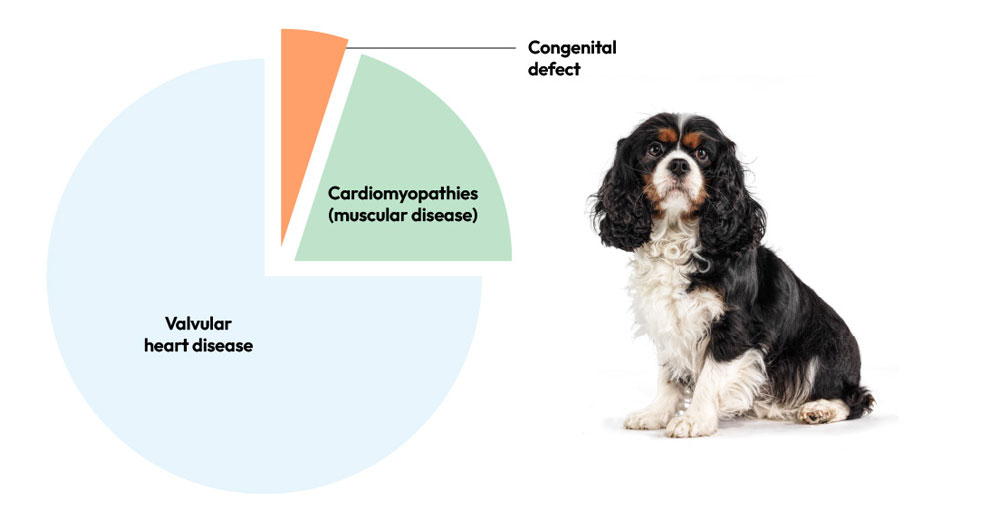
Heart disease affects approximately 10% of all dogs. The majority of cases are acquired, degenerative diseases of the heart valve or the heart muscle. Heart murmurs are often early signs of cardiac disease and so it is important to detect them early and grade them accurately for the best outcomes.

Challenges with heart murmur detection

Many murmurs are subtle and occur at frequencies below the human hearing threshold.16These can be missed during routine check-ups, especially in busy clinics or with restless patients.

Education and resources

Discover educational resources covering the challenges of auscultation in canine cardiology, to the rise of artificial intelligence in veterinary medicine.

Key questions and answers

Visit our FAQ section to uncover answers to key topics that you may have in mind.

Get in touch

Contact us if you have a query on canine heart disease or CANINEBEAT® AI

Large banner Overview page

What it does

CANINEBEAT® AI


  • Has over 95% sensitivity and specificity for detection of heart murmurs related to structural heart disease
  • Grades murmurs
  • Can detect additional auscultatory abnormalities
  • Delivers consistent, repeatable assessments, providing veterinarians with an expert-validated support they can trust.

What it does

CANINEBEAT® AI


  • Has over 95% sensitivity and specificity for detection of heart murmurs related to structural heart disease
  • Grades murmurs
  • Can detect additional auscultatory abnormalities
  • Delivers consistent, repeatable assessments, providing veterinarians with an expert-validated support they can trust.
Large banner Overview page

Who developed it

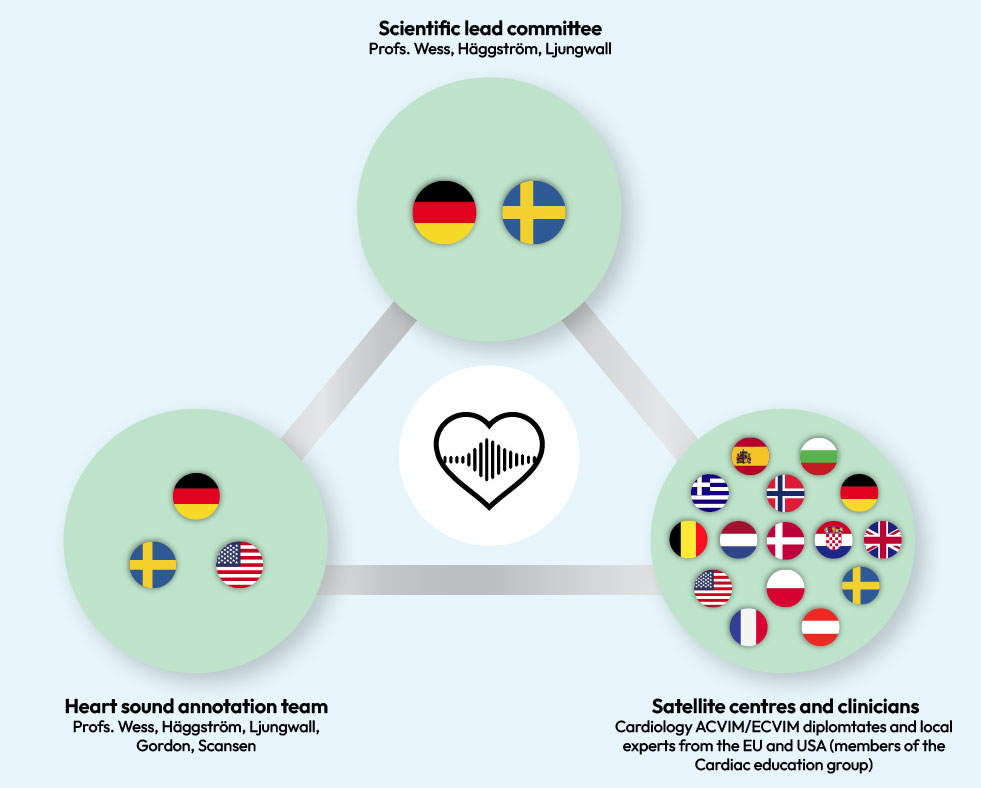
CANINEBEAT® AI was developed by Boehringer Ingelheim and Eko Health, in collaboration with renowned cardiology experts including Prof. Gerhard Wess, Prof. Jens Häggström, and Assoc. Prof. Ingrid Ljungvall. Valuable contributions were also received from Profs. Gordon and Scansen for expert sound annotation and consultancy. In total, almost 50 veterinary cardiologists across the EU and USA were involved, ensuring scientific rigor and clinical relevance.


Image
Prof. Gerhard Wess


Prof. Gerhard Wess
University of Munich, Germany

Image
Prof. Jens Häggström


Prof. Jens Häggström
Swedish University of Agricultural Sciences

Image
Assoc. Prof. Ingrid Ljungvall


Assoc. Prof. Ingrid Ljungvall
Swedish University of Agricultural Sciences

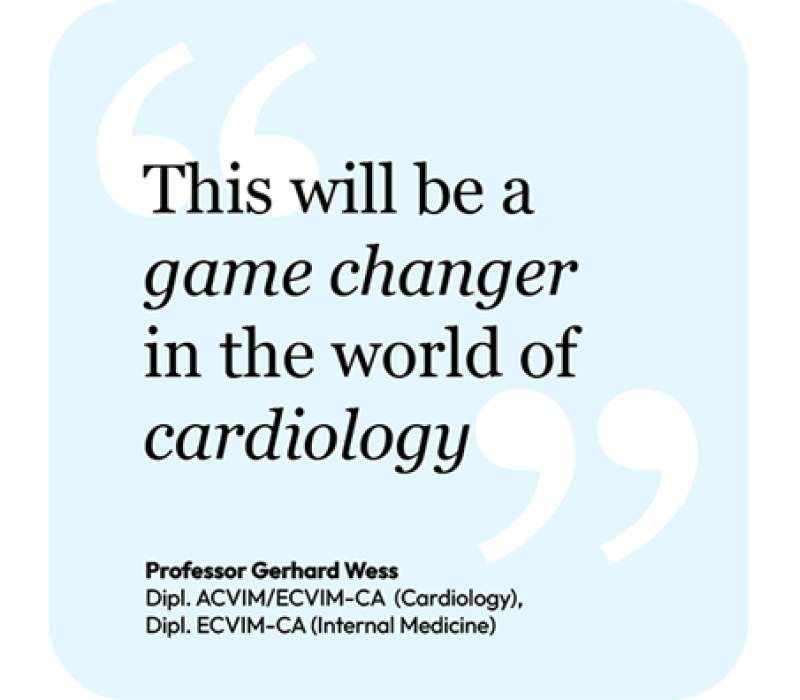
“I have never been involved in a project where so many veterinary cardiologists worked together and in such an intensive manner to collect as many sound samples.”

Professor Jens Häggström, Dipl. ECVIM-CA (Cardiology)

Image of countries involved
The CANINEBEAT® AI algorithm

How it was created

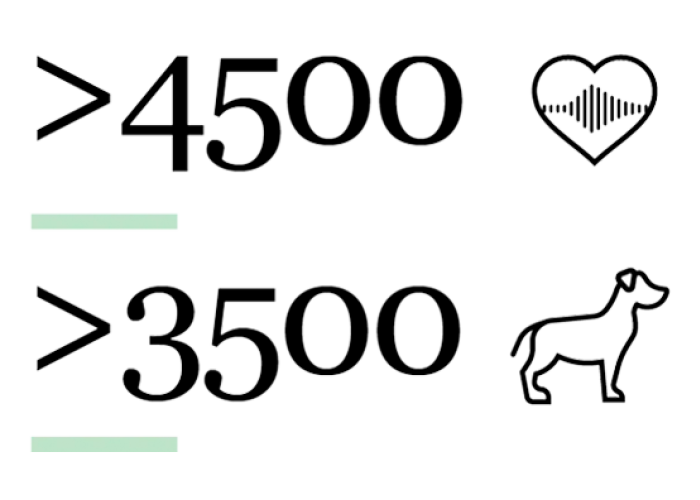
The CANINEBEAT® AI algorithm was trained and validated using over 4500 annotated heart sound recordings from more than 3500 dogs , making it the most extensive digital auscultation study in veterinary medicine to date. The algorithm is a static model, trained on a fixed dataset and deployed without allowing open updates, ensuring it remains unchanged.

How it was created

The CANINEBEAT® AI algorithm was trained and validated using over 4500 annotated heart sound recordings from more than 3500 dogs , making it the most extensive digital auscultation study in veterinary medicine to date. The algorithm is a static model, trained on a fixed dataset and deployed without allowing open updates, ensuring it remains unchanged.

The CANINEBEAT® AI algorithm

 Doctor with a stethoscope on a dog.

Disease overview

Heart disease affects approximately 10% of all dogs. The majority of cases are acquired, degenerative diseases of the heart valve or the heart muscle. Heart murmurs are the earliest sign of cardiac disease, so it is important to detect them early and grade them for the best outcomes.


Disease overview pie chart

Types of Canine Heart Disease

What is Myxomatous Mitral Valve Disease (MMVD)?

The most common cause of canine heart problems is valvular disease.1,2Myxomatous mitral valve disease (MMVD) causes the mitral valve to thicken and become uneven, so the valve cannot form a perfect seal and blood leaks backwards in the wrong direction. MMVD more commonly affects small breeds,3 for example Cavalier King Charles Spaniels, Boston Terriers, Chihuahuas, Fox Terriers, Miniature Pinschers, Poodles, Pekingese, Pomeranians and Whippets.


Key symptoms include a left apical systolic heart murmur resulting from mitral regurgitation.1 MMVD is a progressive condition that leads to congestive heart failure in a substantial proportion of affected dogs,and, if left untreated, high mortality within 6–14 months of onset.5

What is Dilated Cardiomyopathy (DCM)?

In dilated cardiomyopathy (DCM), heart muscle cells do not function properly. The heart dilates secondary to decreased function, enlarging and weakening with walls that are stretched and thin.  Dilation of the valve annulus causes leakage at the mitral valve resulting in a murmur. This disease progresses quickly. DCM more commonly affects large breeds,6,7 for example Doberman Pinschers, Great Danes, Afghan Hounds, Boxers, Cocker Spaniels, Dalmations, Irish Wolfhounds, Newfoundlands, Saint Bernards and Scottish Deerhounds.

What is Congenital Heart Disease (CHD)?

Congenital heart disease (CHD) in dogs refers to structural heart defects present at birth, often inherited or stemming from developmental issues. Although relatively uncommon (approx. 1.6% of dogs), CHD is serious, with commonly reported forms including e.g. pulmonic stenosis (PS), subaortic stenosis (SAS) and patent ductus arteriosus (PDA).8 Clinical signs include lethargy, exercise intolerance, coughing and syncope, typically appearing in puppies or young dogs.

Murmur grading

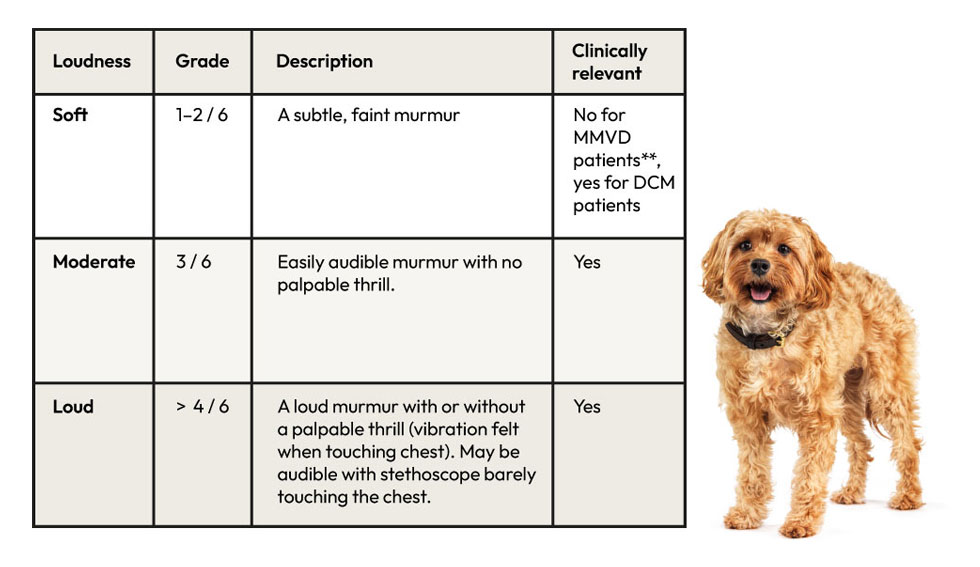
Heart murmurs are commonly graded out of 6, depending on murmur intensity. For development of CANINEBEAT® AI, a simplified* Levine scale was used for ease of use in daily practice.


Murmur grade chart


*The Levine scale categorises heart murmurs into 6 grades.  Profs Wess, Häggström and Assoc. Professor Ljungvall have simplified the Levine scale into 3 levels.
**likelihood of Stage B1 is 95%9

Dogs with relevant cardiomegaly in MMVD typically have “moderate” or “loud” murmurs (Grade ≥3/6).10

Challenges with heart murmur detection

Hard to hear:

Many murmurs are subtle and occur at frequencies below the human hearing threshold.11 These can be missed during routine check-ups, especially in busy clinics or with restless patients. Early-stage heart disease is often asymptomatic and subtle murmurs can go unnoticed and remain undetected


Missed murmurs:

Research has shown that standard auscultation has a sensitivity of just 41% for detecting audible valvular heart disease in humans,12 meaning soft murmurs are often missed. In veterinary medicine, rates of murmur detection seem to depend on observer experience, with inexperienced practitioners and GP veterinarians finding murmur detection particularly challenging.

One study found that every second murmur is missed by recent graduate veterinarians (<1 year).13 Another study found that first-option veterinarians did not record 96 out of 97 soft murmurs in apparently healthy puppies that were recorded by a cardiologist.14 Higher murmur detection rates were seen with more experienced clinicians in a study of cardiologists, referral veterinarians, veterinary students and recent graduates. The recent graduates missed 25–75% of systolic murmurs.15


CANINEBEAT® AI can help veterinarians detect even subtle canine heart murmurs with high sensitivity.


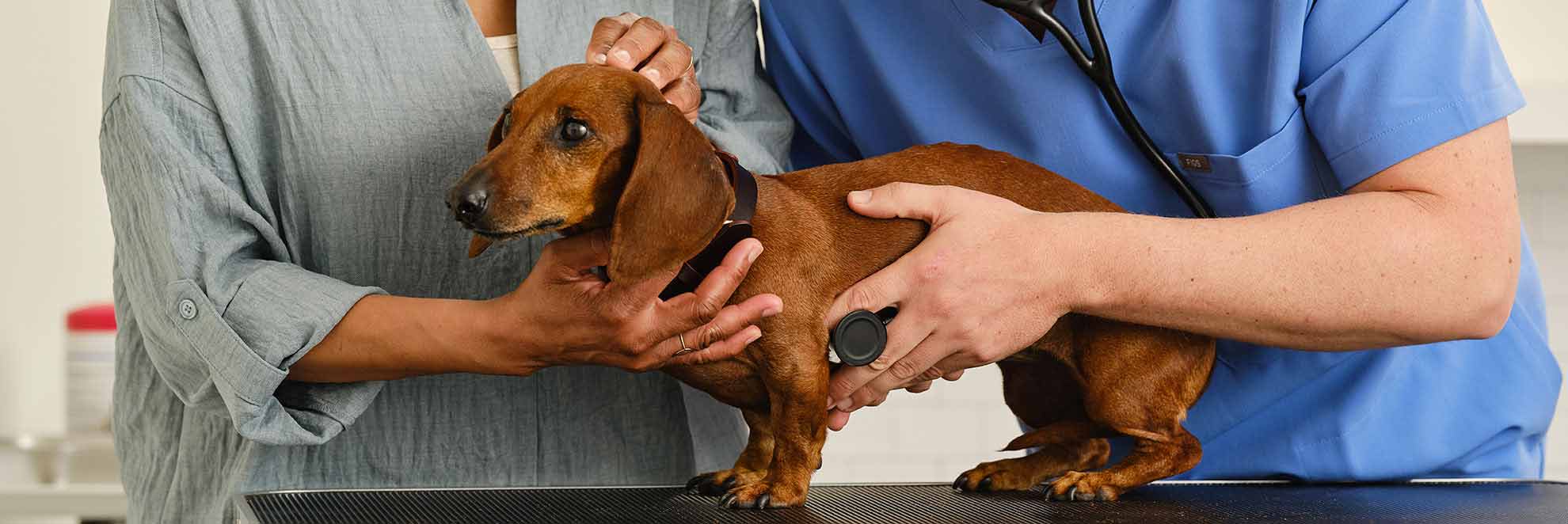
Daschund dog held by two people

Evaluation of an artificial intelligence-enabled digital stethoscope for detecting undiagnosed human valvular heart disease

This technical bulletin highlights how traditional cardiac auscultation in human medicine was enhanced using an AI-enabled digital stethoscope. In this real-world evaluation, improved sensitivity led to better detection of valvular heart disease, earlier diagnosis and potentially improved outcomes.


Missed murmurs: hiding in plain sight

This technical bulletin covers the potential of AI tools in improving diagnostic accuracy in veterinary medicine. It looks at observer experience in murmur detection, the likelihood of veterinary students and inexperienced practitioners detecting murmurs, and the training needed to prevent murmurs from being missed.


The role of artificial intelligence in human and veterinary medicine: current applications and future opportunities

AI is transforming the landscape of healthcare, offering tools that can enhance diagnostics, optimise workflows and improve patient outcomes. Human medicine has already adopted AI in a wide range of areas, and veterinary medicine is now beginning to use some of these tools. This article summarises some of the current applications of AI in human and veterinary healthcare and explores potential areas for expansion in veterinary practice.

Download

Select All

Download

Resources

Download the My Pet’s Heart2Heart app. Today

Resting respiratory rate (RRR) is a proven tool to help identify and manage dogs with congestive heart failure: as heart disease progresses, RRR will increase. This app allows pet owners to count and record their pet’s RRR over time, and upload this information directly to their veterinarian.

Download the My Pet’s Heart2Heart app. Today

Resting respiratory rate (RRR) is a proven tool to help identify and manage dogs with congestive heart failure: as heart disease progresses, RRR will increase. This app allows pet owners to count and record their pet’s RRR over time, and upload this information directly to their veterinarian.

A vet petting a golden retriever along with his owner

Q: Who developed the CANINEBEAT® AI algorithm?

A: The algorithm was developed by Boehringer Ingelheim and Eko Health. It has been trained and validated with input from renowned experts including Prof. Gerhard Wess, Prof. Jens Häggström, and Assoc. Prof. Ingrid Ljungvall. Valuable contributions were also received from Profs. Gordon and Scansen for expert sound annotation and consultancy. In total, almost 50 veterinary cardiologists across the EU and USA were involved, ensuring scientific rigor and clinical relevance.

Q: How will CANINEBEAT® AI help veterinary general practitioners?

A: Trained on thousands of expert-annotated heart sounds, CANINEBEAT® AI provides expert‑validated, AI‑supported assistance in everyday practice, helping clinicians detect and grade murmurs with greater confidence.

Q: How accurate is the CANINEBEAT® AI algorithm?

A: The specificity and sensitivity of CANINEBEAT® AI for detecting a murmur (yes vs no) related to structural heart disease is over 95%.

Q: How reliable is the CANINEBEAT® AI algorithm?

A: The CANINEBEAT® AI algorithm is ‘static’, which means it is trained on a fixed dataset provided by cardiologists and deployed without allowing open updates, so that the algorithm remains unchanged over time and delivers consistent and repeatable murmur assessments across every patient and every visit.

Q: Does CANINEBEAT® AI replace echocardiography and radiography?

A: No. CANINEBEAT® AI does not replace diagnostic imaging. It is a supportive tool designed to aid veterinarians in the detection and grading of possible heart murmurs as part of the clinical examination. Decisions on further diagnostic steps, including whether and when to use imaging, remain entirely based on the veterinarian’s clinical judgement, the individual patient, and the overall clinical context.

Q: How should I use CANINEBEAT® AI?

A: CANINEBEAT® AI will be part of a solution coming soon that every veterinarian can use in clinic every day, to improve detection and communication of heart murmurs.

Q: Where can I buy CANINEBEAT® AI?

A: It is not currently on sale. It will be sold from the end of April onwards in specific regions of the world as part of an easy-to-use digital auscultation solution for every veterinarian.

Q: What does CANINEBEAT® AI cost?

A: Please ask your Boehringer Ingelheim representative for more information.

Learn more

For queries about CANINEBEAT® Al, contact your local Boehringer Ingelheim representative.

For all other medical technical support and queries on canine heart disease, please contact your local Boehringer Ingelheim technical team.

References

  1. Atkins C, Bonagura J, Ettinger S, et al. Guidelines for the diagnosis and treatment of canine chronic valvular heart disease. J Vet Intern Med. 2009;23:1142–1150.
  2. Guglielmini C. Cardiovascular diseases in the aging dog: diagnostic and therapeutic problems. Vet Res Commun. 2003;27 Suppl 1:555–560.
  3. Rush JE. Chronic valvular heart disease in dogs. Proceedings from the 26th Annual Waltham Diets/OSU Symposium for the Treatment of Small Animal Cardiology; October 19–20, 2002.
  4. Keene BW, Atkins CE, Bonagura JD, et al. ACVIM consensus guidelines for the diagnosis and treatment of myxomatous mitral valve disease in dogs. J Vet Intern Med. 2019;33:1127–1140.
  5. Borgarelli M and Buchanan JW. Historical review, epidemiology and natural history of degenerative mitral valve disease. J Vet Cardiol 2012;14(1):93–101.
  6. O’Grady MR, Minors SL, O’Sullivan ML, Horne R. Effect of pimobendan on case fatality rate in Doberman pinschers with congestive heart failure caused by dilated cardiomyopathy. J Vet Intern Med. 2008;22:897–904.
  7. Ware WA. Cardiovascular Disease in Small Animal Medicine. Ames, IA: Blackwell Publishing Professional; 2007.
  8. Lucina SB, Sarraff AP, Wolf M, et al. Congenital heart disease in dogs: A retrospective study of 95 cases. Topics Compan Anim Med 2021;43.
  9. The Listen Study. 2026. Publication in submission.
  10. Ljungvall I, Rishniw M, Porciello F, et al. Murmur intensity in small-breed dogs with myxomatous mitral valve disease reflects disease severity. J Small Anim Pract. 2014;55:545-50.
  11. Ljungvall I, Ahlstrom C, Höglund K, et al. Use of signal analysis of heart sounds and murmurs to assess severity of mitral valve regurgitation attributable to myxomatous mitral valve disease in dogs. Am J Vet Res. 2009;70:604-613.
  12. Rancier MA et al. Abstract 13244: Real world evaluation of an artificial intelligence enabled digital stethoscope for detecting undiagnosed valvular heart disease in primary care. Meeting Abstract: American Heart Association 2023 Scientific Sessions and the American Heart Association 2023 Resuscitation Science Symposium. Circulation. 2023;148 (Suppl 1).
  13. Pedersen HD, Haggstrom J, Falk T, et al. Auscultation in mild mitral regurgitation in dogs: observer variation, effects of physical maneuvers, and agreement with color Doppler echocardiography and phonocardiography. J Vet Intern Med 1999;13:56-64. 
  14. van Staveren MDB, Szatmari V. Detecting and recording cardiac murmurs in clinically healthy puppies in first opinion veterinary practice at the first health check. Acta Vet Scand 2020;62:37.
  15. Mullowney D, Fuentes VL, Barfield D. Cardiac auscultation skills in final year veterinary students and recent veterinary graduates, referral hospital veterinary surgeons and veterinary cardiologists or cardiology residents. Vet Rec 2021;189:e305.
  16. Christer Ahlström (2006). Processing of the Phonocardiographic Signal − Methods for the Intelligent Stethoscope. Doctoral dissertation. Department of Biomedical Engineering, Linköpings universitet, Sweden.